
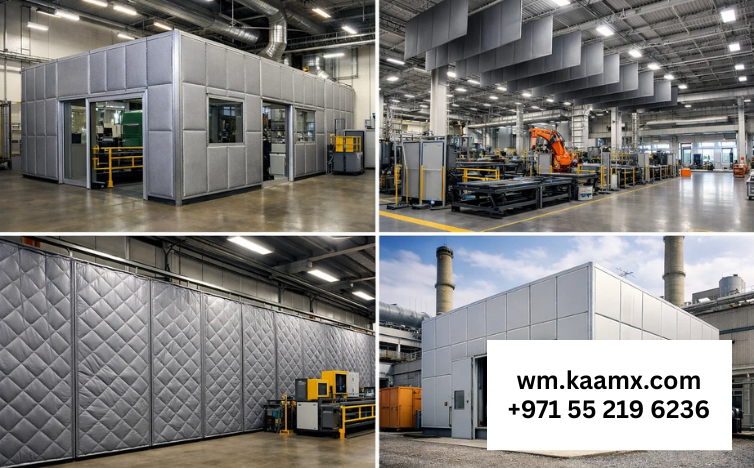
Walk into any factory or warehouse and the first thing you notice isn’t the machines. It’s the noise. Constant. Heavy. Unavoidable. And here’s the problem—most facilities treat it like “normal.” But industrial noise isn’t harmless background sound. It directly impacts worker safety, performance, and even business profitability.
That’s why industrial soundproofing isn’t a luxury upgrade. It’s a functional requirement.
The Hidden Cost of Industrial Noise
Noise in industrial environments doesn’t just stay in the background—it affects everything happening on the floor.
A 2025 study published in BMC Public Health found that workers exposed to higher industrial noise levels showed reduced work performance and increased hearing-related issues, even when noise stayed within “acceptable” limits.
That means even “moderate” noise is already a problem.
Beyond hearing damage, industrial noise leads to:
- Lower concentration
- Increased errors in tasks
- Higher stress levels
- Communication breakdowns
And when communication fails in a factory, mistakes aren’t small—they’re costly.
Why Industrial Soundproofing Matters More Than You Think
Industrial environments are fundamentally different from offices or homes.
You’re dealing with:
- Heavy machinery
- Continuous vibration
- Large open spaces
- Reflective surfaces like metal and concrete
According to acoustic industry data, reducing noise levels in factories directly improves worker focus and reduces errors, which ultimately increases productivity.
So this isn’t just about comfort.
It’s about efficiency, safety, and compliance.
Where Most Factory Noise Actually Comes From
Before choosing any solution, the real issue needs to be identified.
Common industrial noise sources include:
- Compressors and generators
- CNC machines and cutting tools
- Conveyor systems
- Ventilation and HVAC units
- Impact and vibration from production processes
Each of these creates different types of noise—some airborne, some structural.
And that’s why one single solution never works.
The Core Industrial Soundproofing Solutions
Effective soundproofing in industrial facilities always involves a combination of solutions—not just one product.
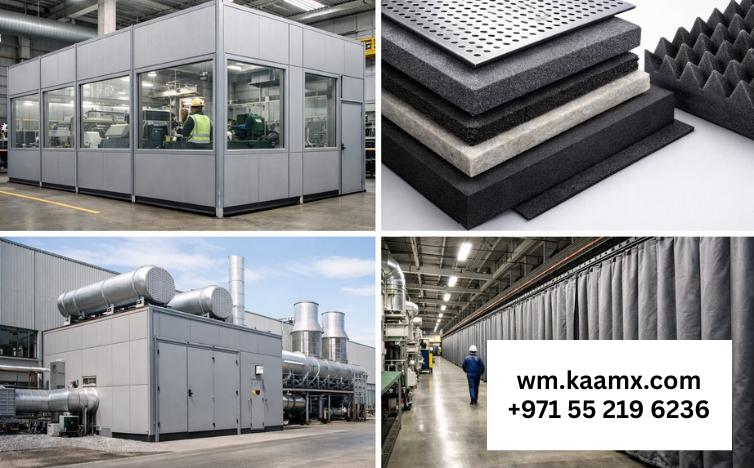
Acoustic Enclosures for Machinery
One of the most effective solutions is isolating the noise at its source.
Acoustic enclosures are designed to surround loud machines and prevent sound from spreading across the facility.
These systems:
- Contain high-decibel noise
- Reduce exposure for nearby workers
- Improve overall acoustic control
They are especially useful for compressors, generators, and heavy-duty equipment.
Acoustic Wall Panels for Large Spaces
Factories often have large, open layouts where sound travels freely and reflects off hard surfaces.
Acoustic wall panels help absorb this reflected sound, reducing echo and overall noise levels.
They are typically installed:
- Around production zones
- Along walls near machinery
- In areas with high reverberation
Instead of letting sound bounce around endlessly, panels absorb it and stabilize the environment.
Ceiling Treatments for Echo Control
In industrial spaces, ceilings are often ignored—but they play a major role in noise buildup.
Sound travels upward, reflects, and comes back down.
Solutions like:
- Acoustic ceiling baffles
- Suspended ceiling panels
help reduce this reflection and control sound from above.
This is especially important in warehouses and large halls with high ceilings.
Sound Barriers and Partitioning
Sometimes the goal isn’t to eliminate noise—but to control where it goes.
Acoustic barriers and partitions are used to:
- Separate noisy zones from quiet areas
- Protect specific workstations
- Create controlled environments within large facilities
This approach is commonly used in assembly lines and multi-zone factories.
Vibration Isolation Systems
Not all industrial noise travels through air. A significant portion travels through structure—floors, walls, and machinery bases.
This is where vibration isolation comes in.
By using:
- Anti-vibration mounts
- Isolation pads
- Floating floors
facilities can reduce structure-borne noise before it spreads.
This is critical for heavy machinery setups.
Why One Solution Is Never Enough
Here’s where many facilities go wrong.
They install one solution—like panels—and expect full results.
But industrial noise is multi-directional. It travels:
- Through air
- Through structure
- Around obstacles
Which means soundproofing must be layered and strategic.
For example:
- Enclosures handle source noise
- Panels control reflections
- Barriers manage sound direction
- Isolation reduces vibration
Only when these work together does the environment actually improve.
Compliance and Safety: The Non-Negotiable Factor
Industrial noise isn’t just a comfort issue—it’s regulated.
Organizations like NIOSH recommend protective measures when workers are exposed to 85 dB or higher over 8 hours.
Without proper soundproofing:
- Facilities risk non-compliance
- Worker health issues increase
- Liability becomes a concern
Soundproofing helps businesses meet safety standards while protecting their workforce.
Real Impact on Productivity
Noise doesn’t just damage hearing—it disrupts thinking.
Studies show that noisy environments:
- Reduce cognitive performance
- Increase mental fatigue
- Lead to more operational errors
In industrial settings, that translates to:
- Slower workflows
- Increased downtime
- Higher operational costs
Reducing noise isn’t just about silence—it’s about smoother operations.
Choosing the Right Industrial Soundproofing Approach
Every facility is different. The right solution depends on:
- Type of machinery
- Noise levels (dB)
- Layout and ceiling height
- Type of operations
That’s why professional assessment matters. Services like those offered by warehouse and factory soundproofing providers focus on analyzing the entire environment—not just selling products.
Because in industrial acoustics, design matters more than materials alone.
Contact Muhammad Shaheen Carpentry at 971 55 219 6236, and discover the transformative science of soundproofing for your space.
Final Thought
Industrial noise is one of those problems that slowly drains performance, safety, and efficiency—without being immediately obvious. Most facilities adapt to it instead of fixing it.