
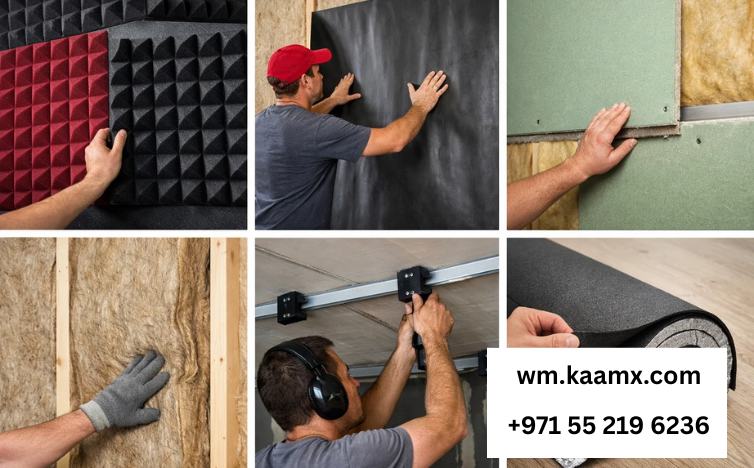
Noise control in modern spaces requires more than basic treatments. Whether it’s residential, commercial, or industrial environments, choosing the right soundproofing materials for walls and ceilings is essential for achieving effective noise reduction. The key is understanding that no single material works alone—professional results come from combining multiple soundproofing layers that block, absorb, and isolate sound.
Understanding How Soundproofing Materials Work
Before selecting materials, it is important to distinguish between soundproofing and acoustic treatment. Soundproofing materials are designed to block sound transmission between spaces, while acoustic materials absorb sound within a room to reduce echo and reverberation. Most effective systems use a combination of both approaches to achieve balanced results.
Acoustic Panels for Walls and Ceilings
Acoustic panels are one of the most widely used materials for both walls and ceilings. These panels are made from foam, fiberglass, or mineral wool and are designed to absorb sound waves, reducing echo and improving clarity inside a space. They are particularly effective in offices, studios, restaurants, and meeting rooms where sound reflection is a major issue.
When installed on walls, acoustic panels target reflection points, while ceiling-mounted panels help control sound in large or open areas where noise tends to bounce from above.
Soundproof Insulation (Rockwool & Fiberglass)
Insulation materials such as rockwool and fiberglass are essential for blocking airborne noise within wall cavities and ceiling structures. These materials are dense and fibrous, which allows them to trap sound waves and reduce transmission between rooms.
Rockwool offers higher density and better fire resistance, while fiberglass is a more budget-friendly option. Both are commonly used in layered soundproofing systems to improve overall performance.
Acoustic Drywall (Soundproof Plasterboard)
Acoustic drywall is a high-performance material specifically engineered to block sound. It is thicker than standard drywall and often includes damping layers that reduce sound transmission significantly.
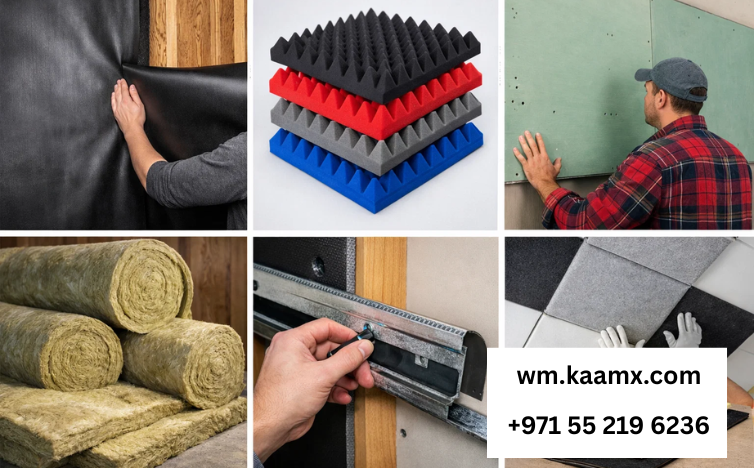 When combined with damping compounds like Green Glue, acoustic drywall can achieve substantial noise reduction, making it ideal for walls and ceilings in apartments, offices, and industrial spaces.
Mass Loaded Vinyl (MLV)
Mass Loaded Vinyl is a dense, flexible material used to add mass to walls and ceilings without taking up much space. It is highly effective at blocking sound, especially low-frequency noise such as machinery or bass vibrations.
MLV is typically installed between layers of drywall or inside wall systems to enhance soundproofing performance.
Resilient Channels and Decoupling Systems
Resilient channels are metal strips used to separate drywall from the structural frame of a building. This decoupling technique prevents vibrations from passing through walls and ceilings, significantly reducing noise transfer.
These systems are particularly effective for ceiling soundproofing, where impact noise such as footsteps is a concern.
Acoustic Foam and Ceiling Panels
Acoustic foam is commonly used for quick and cost-effective sound absorption. It reduces echo and improves sound quality but does not fully block sound. For ceilings, foam panels or acoustic ceiling tiles are often installed to control noise in large spaces.
Ceiling treatments are especially important because large, flat ceiling surfaces can reflect and amplify sound throughout a room if left untreated.
Why Combining Materials Gives Better Results
Using a single material rarely delivers complete soundproofing. Effective noise control requires a layered system that includes:
- Mass (drywall, MLV) to block sound
- Absorption (panels, insulation) to reduce reflections
- Decoupling (channels) to stop vibration transfer
Combining these elements creates a comprehensive solution that addresses both airborne and structural noise. This approach is widely used in professional soundproofing projects for walls and ceilings.
Choosing the Right Material for Your Space
The best soundproofing materials depend on the type of noise and the environment. For example, offices and studios benefit more from acoustic panels, while industrial or high-noise environments require dense materials like insulation, MLV, and acoustic drywall.
Ceilings often need additional treatment compared to walls, especially in multi-story buildings where noise travels between floors. Selecting the right combination ensures long-term performance and cost efficiency.
Contact Muhammad Shaheen Carpentry at 971 55 219 6236, and discover the transformative science of soundproofing for your space.
Conclusion
Choosing the best soundproofing materials for walls and ceilings is not about selecting a single product—it’s about building an effective system. Acoustic panels, insulation, drywall, and decoupling solutions all play a role in controlling noise.
For optimal results, a combination of materials tailored to your specific noise problem will always outperform standalone solutions, delivering better comfort, privacy, and acoustic performance.