
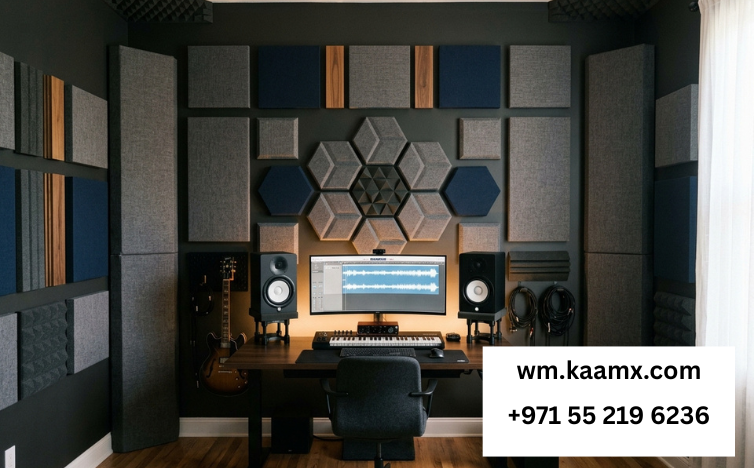
Most people think acoustic treatment is about installing a few panels on the wall and expecting instant results. That approach rarely works. A complete acoustic setup is not built on a single product—it’s a system where multiple solutions work together to control sound effectively. Whether you are starting from scratch or upgrading to a professional-level setup, understanding how different acoustic products interact is the key to achieving real performance.
Sound behaves in layers. Some frequencies reflect, some pass through structures, and others build up in specific areas. That’s why relying on just one type of material leads to incomplete results. A proper acoustic setup combines absorption, blocking, and vibration control to create a balanced environment.
Why One Product Is Never Enough
Acoustic performance depends on how well different materials handle different types of sound. Some products absorb echo, while others block sound transmission or reduce vibration. High-quality acoustic systems are always designed as a combination of materials because each product serves a specific function in the overall setup.
For example, acoustic panels are effective for reducing echo and improving clarity, but they do not stop sound from entering or leaving a room. Similarly, dense barriers can block sound but do little to control reflections inside the space. This is why combining multiple acoustic products is essential for achieving both sound quality and sound isolation.
Beginner Setup: Fixing Echo and Basic Noise Issues
At the beginner level, the focus should be on controlling reflections and improving clarity. Most untreated rooms suffer from echo caused by hard surfaces such as walls, ceilings, and floors.
A basic setup typically includes wall-mounted acoustic panels and simple ceiling treatments. These products absorb mid and high frequencies, reducing echo and making speech or music clearer. Adding soft materials like carpets and curtains can further enhance absorption and improve overall comfort.
This stage does not require heavy structural changes. Instead, it focuses on improving the internal acoustic environment using simple and cost-effective solutions.
Intermediate Setup: Adding Control and Balance
Once basic echo is controlled, the next step is to address sound balance and frequency control. At this stage, additional products are introduced to improve overall performance.
Ceiling baffles or rafts are commonly used to manage overhead reflections, especially in larger spaces. Bass traps are added to control low-frequency buildup, which often causes a “boomy” or uneven sound. These are typically installed in corners where low frequencies accumulate.
At the same time, improving sealing around doors, windows, and joints helps reduce sound leakage. This step begins to move the setup from simple acoustic treatment toward a more controlled and efficient system.
Advanced Setup: Blocking and Isolation
For professional-level performance, soundproofing elements must be integrated into the system. This includes adding mass and creating barriers that prevent sound from traveling between spaces.
Products such as acoustic drywall, insulation materials, and sound barriers are used to block airborne noise. These materials increase the density of walls and ceilings, making it harder for sound to pass through.
Decoupling techniques, such as resilient channels or floating structures, are also introduced to reduce vibration transfer. This is especially important in environments where low-frequency noise or mechanical vibration is a concern.
At this level, the setup is no longer just about improving sound inside the room—it is about controlling how sound moves in and out of the space.
Professional Setup: Full System Integration
A professional acoustic setup combines all elements into a single, well-designed system. This includes absorption, diffusion, sound blocking, and vibration isolation working together.
Acoustic panels, ceiling systems, and diffusers are strategically placed to manage reflections and maintain sound clarity. At the same time, dense materials and barriers ensure that external noise is minimized. Specialized products such as acoustic enclosures, ceiling clouds, and advanced wall systems are often used in high-performance environments.
The key difference at this stage is precision. Every product is selected and positioned based on the specific acoustic requirements of the space, resulting in consistent and reliable performance.
The Role of Product Combination in Real Results
Modern acoustic solutions are designed to address different aspects of sound control, including absorption, diffusion, and sound blocking.
When these products are combined correctly:
- Echo is reduced
- Noise transmission is controlled
- Sound clarity is improved
- Overall comfort is enhanced
This layered approach ensures that no single weakness affects the entire system, which is why professional setups always outperform basic installations.
Choosing the Right Products for Your Space
Selecting the right acoustic products depends on the type of space and the specific problem you are trying to solve. Offices and meeting rooms require clarity and speech control, while industrial environments need stronger noise reduction and vibration management.
The size of the room, surface materials, and noise sources all influence which products should be used. A small room may only need panels and basic ceiling treatment, while larger or noisier spaces require a combination of multiple solutions.
Contact Muhammad Shaheen Carpentry at 971 55 219 6236, and discover the transformative science of soundproofing for your space.
Conclusion
A complete acoustic setup is built step by step, not all at once. Starting with basic absorption and gradually adding advanced solutions allows you to create a system that meets your needs and budget.
The most important thing to understand is that no single product can solve all acoustic problems. Real results come from combining the right materials in the right way. When done correctly, this approach transforms any space into a controlled, comfortable, and acoustically efficient environment.