

Abu Dhabi operates differently from Dubai. The pace is more deliberate. The commercial culture is more formal. The government sector is larger, the private sector more institutionally anchored, and the built environment reflects both — wider roads, larger building setbacks, more generous floor plates. For anyone who moves between the two cities regularly, Abu Dhabi feels quieter almost by definition.
But quieter than Dubai is not the same as quiet enough for work.
The open-plan offices in Al Maryah Island’s financial district, the government ministry buildings across the capital, the corporate headquarters in Khalidiyah and Corniche Road, the growing commercial clusters in Masdar City and Yas Island — all of these share the same acoustic failure modes that affect commercial offices everywhere. Noise that kills concentration. Conference rooms that can’t contain a conversation. Shared walls between tenanted spaces that transmit everything. HVAC systems that hum through every quiet moment.
The solutions are available. The specification needs to match Abu Dhabi’s specific office typologies.
Abu Dhabi’s Office Building Stock — What Makes It Acoustically Distinct
Abu Dhabi’s commercial building stock has characteristics that differentiate it acoustically from Dubai’s and that matter for treatment specification.
The capital’s larger government sector means a significant proportion of Abu Dhabi’s office space sits in purpose-built government ministry buildings and semi-government entity headquarters — buildings that were often constructed with generous floor-to-ceiling heights, robust concrete construction, and more substantial external wall specification than typical commercial speculative builds. This construction quality helps at the facade level — external noise intrusion from Abu Dhabi’s roads is generally less problematic than in Dubai’s denser commercial districts. The primary acoustic problems in Abu Dhabi government offices are almost universally internal: open-plan noise between workstations, conference room containment, and HVAC drone.
Abu Dhabi’s private sector commercial offices concentrate in Al Maryah Island, Al Reem Island, and the Corniche corridor — a mix of glass curtain wall towers and older commercial buildings from the 1990s and early 2000s that have been extensively retrofitted. The tower stock has the typical glass facade acoustic weakness. The older commercial buildings in Khalidiyah and Hamdan Street have their own acoustic challenges — smaller floor plates, more tenanted adjacency, older construction details that weren’t designed with modern acoustic standards in mind.
Masdar City deserves specific mention. Abu Dhabi’s sustainability flagship development has attracted technology companies, research institutions, and innovation-focused businesses whose knowledge work is specifically the most noise-sensitive category of professional activity. The sustainable building spec at Masdar prioritises thermal and energy performance — acoustic performance has received less consistent attention, leaving some of Abu Dhabi’s most cognitively demanding workplaces in spaces that don’t acoustically support the work happening in them.
Open-Plan Offices — The Primary Problem Everywhere
The shift to open-plan office layouts across Abu Dhabi’s private and increasingly government sector has produced the same outcome it produces everywhere: noise environments that systematically undermine the concentration that knowledge work requires.
The research on this is not ambiguous. A 2019 study from Oxford Economics found that employee performance on complex cognitive tasks drops measurably in open-plan noise environments, with workers losing an average of 86 minutes of productive time daily to noise-related distraction. In Abu Dhabi’s government sector — where decision quality, document accuracy, and policy deliberation are the core work product — this performance degradation has direct operational consequences that extend beyond individual productivity to institutional effectiveness.
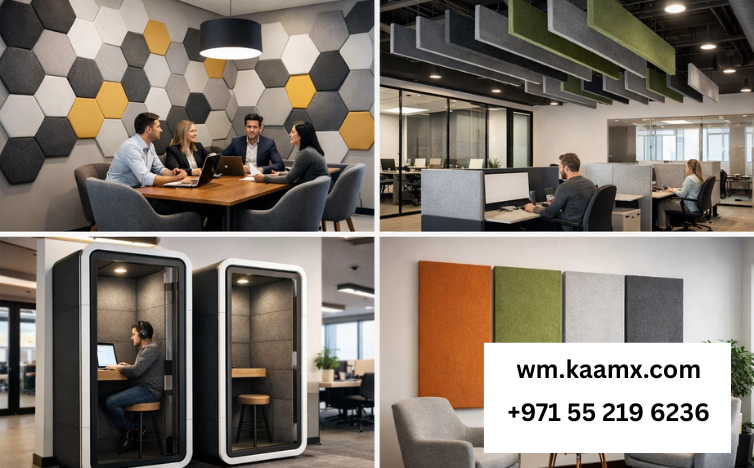
The acoustic treatment response for Abu Dhabi open-plan offices follows the same product logic as any comparable environment, applied to the specific spatial characteristics of Abu Dhabi’s floor plates. PET acoustic panels on perimeter walls and feature walls reduce the reverberation time that large hard-surfaced rooms generate. Ceiling baffles address the ceiling plane in open areas where direct ceiling treatment isn’t practical. Acoustic partitions and screens between workstation clusters manage horizontal sound transmission across the floor plate without creating the visual enclosure that defeats the purpose of open-plan layout.
The target reverberation time for open-plan office spaces — 0.6 to 0.8 seconds — is achievable in virtually any Abu Dhabi office with appropriate panel coverage. The shift in how the space feels at that reverberation time is immediately perceptible: the ambient noise floor drops, individual voices don’t carry across the entire floor, and the self-reinforcing cycle where everyone speaks louder to be heard over everyone else stops building.
Government and Semi-Government Buildings — The Confidentiality Dimension
Abu Dhabi’s government sector has an acoustic requirement that commercial offices sometimes treat as optional: conversation privacy in spaces where sensitive information is discussed. This is not optional in a government context. Policy discussions, budget deliberations, personnel matters, and regulatory decisions all require acoustic containment that standard government office construction frequently doesn’t provide.
The consultation room in an Abu Dhabi government ministry with a standard lightweight partition and a hollow-core door is structurally incapable of containing a conversation. Sound transmits through the partition at levels that make conversations intelligible to anyone in the adjacent corridor or waiting area. This is not a hypothetical risk — it’s the daily operating reality of most such spaces across Abu Dhabi’s government sector, normalised through familiarity rather than addressed through specification.
The treatment stack for government consultation and decision rooms is straightforward in product terms: acoustic wall panels or MLV on shared walls for improved transmission loss, acoustic doors with compression perimeter seals replacing standard hollow-core doors, and acoustic glass where glazed panels exist in the partition. Together these create a room that genuinely contains conversations rather than broadcasting them. The specification cost is modest relative to any government building’s operating budget. The institutional risk it eliminates is not modest at all.
Conference Rooms — The Most Consistently Misspecified Space in Abu Dhabi Offices
Walk through any commercial office building in Al Maryah Island or the Corniche corridor, access a conference room, and close the door. In most of them, the conversations happening in the adjacent space — the main office floor, the corridor, the next meeting room — are partially audible. The conference room achieves spatial separation without acoustic separation.
This failure is almost always construction specification rather than poor materials. The conference room partition was built to the minimum commercial partition spec — single-layer plasterboard on a metal stud frame, with standard acoustic insulation batt in the cavity. This construction achieves roughly STC 35 to 40 in ideal laboratory conditions. In real-world installation, with the gaps around cable penetrations, the unsealed junction at the ceiling grid, and the standard hollow-core door that STC 25 represents in practice, the assembled system’s effective performance is considerably lower.
 Retrofitting an Abu Dhabi conference room to proper acoustic performance doesn’t require demolishing the partitions. MLV applied to the existing partition surface adds significant blocking mass without structural work. The acoustic door replacement — a solid-core door with compression seals on all four perimeter sides and a drop seal at the threshold — closes the transmission path that the door gap represents. Acoustic ceiling tiles replacing standard grid tiles in the suspended ceiling contribute meaningfully to both internal absorption and ceiling transmission loss. This combination transforms a conference room from a broadcasting facility into one that actually contains its conversations.
The HVAC Noise Problem Abu Dhabi Offices Underestimate
Abu Dhabi’s climate demands more aggressive air conditioning than almost anywhere in the world. Summer temperatures regularly exceed 45°C, and office HVAC systems run at their maximum capacity for four to five months of the year. The acoustic consequence of this demand is a background HVAC noise level in Abu Dhabi offices that is meaningfully higher than comparable offices in more temperate climates.
HVAC noise in offices operates through two distinct mechanisms that require different treatment approaches. Airborne HVAC noise — the sound of air turbulence at diffusers and the mechanical sound of air handling units — travels through the air and is addressed through standard acoustic absorption treatment. Structural HVAC noise — vibration from compressors, fans, and pumps transmitted through the building structure — requires vibration isolation at the mechanical plant rather than surface treatment in the occupied space.
The practical test for which mechanism is dominant: does the HVAC noise change character when you’re close to a diffuser versus away from it? If the noise is significantly louder near diffusers and grilles, airborne turbulence is the primary source and duct lining and diffuser selection address it. If the noise has a consistent low-frequency character that’s equally present everywhere in the room regardless of proximity to diffusers, structural vibration transmission is the likely source — a mechanical engineering intervention rather than a surface treatment one.
For Abu Dhabi offices where HVAC noise is a documented complaint, the assessment of which mechanism is operating determines whether the solution sits in acoustic product specification or in mechanical engineering consultation. wm.kaamx.com’s acoustic services team covers Abu Dhabi as part of their UAE service territory and can conduct this assessment as the starting point for a specification that actually addresses the source rather than treating the symptom.
Al Reem Island and Al Maryah — The Glass Tower Acoustic Challenge
Abu Dhabi’s newer commercial clusters on Al Reem Island and Al Maryah Island are dominated by glass curtain wall tower construction — the same architectural language that characterises Dubai’s business districts and carries the same acoustic weaknesses at the facade level.
Standard structural glazing achieves STC ratings of 26 to 32 in practice. For offices facing the major arterials connecting Al Reem Island and Al Maryah to the main Abu Dhabi road network — Hazza Bin Zayed Street, Al Salam Street — this glass performance permits significant traffic noise intrusion into perimeter offices and meeting rooms. The higher the floor, the more exposed the glazing is to open road noise without the attenuation that building mass and urban canyon effects provide at street level.
Acoustic laminated glass — with PVB interlayer and multi-layer construction achieving STC 38 to 52 — addresses this directly. For Abu Dhabi tenants in glass tower buildings who control their own fit-out and have glazed external offices, acoustic glass replacement is the most impactful single intervention available for perimeter room noise. For tenants who don’t control the facade glazing, the alternative is supplementary internal glazing — a second glazed layer installed inside the existing facade with an air gap — which achieves comparable combined performance through the double-leaf principle.
The Acoustic Pod Solution for Abu Dhabi’s Growing Hybrid Workforce
Abu Dhabi’s commercial sector has adopted hybrid working patterns at pace since 2020, and the office environments adapting to hybrid work have a specific new acoustic requirement: individual call and video conference spaces that don’t require booking a full conference room for a single-person call.
Acoustic pods — self-contained soundproof units ranging from single-person phone booths to four-person meeting configurations — provide this capability without permanent construction. They can be positioned anywhere on an office floor, relocated as needs change, and removed when a tenancy ends without any modification to the building fabric. For Abu Dhabi businesses in short-term or flexible leases — increasingly common as the market matures — this flexibility is a genuine operational advantage over fixed room construction.
The pod’s acoustic performance matters significantly in Abu Dhabi’s climate context. Pods that were designed for European office environments with lower ambient temperatures run warmer in Abu Dhabi’s AC-heavy interiors than their ventilation systems were specified for. Confirming that the pod’s ventilation design is rated for the ambient temperature of a Gulf office environment — not just the nominal specification — is a due diligence step that prevents the occupant comfort problems that undersized ventilation creates in extended use.
Contact Muhammad Shaheen Carpentry at 971 55 219 6236, and discover the transformative science of soundproofing for your space.
Making the Case Internally — The Abu Dhabi Business Context
Abu Dhabi’s corporate culture places significant weight on formal process and documented justification for capital expenditure. The acoustic treatment conversation in an Abu Dhabi office often needs to be made as a business case rather than a preference — and the business case for soundproofing is well-supported by available evidence.
The productivity cost of uncontrolled office noise — quantified at 86 minutes of lost productive time per employee per day by Oxford Economics research — translates directly to salary cost in any organisation. An Abu Dhabi professional services firm with 40 employees and average salary costs of AED 15,000 per month is losing the equivalent of approximately AED 145,000 in monthly productive capacity to noise-related distraction. A comprehensive acoustic treatment investment of AED 50,000 to AED 120,000 for a mid-size office recovers this cost in less than one month of restored productivity — a ROI calculation that any CFO can evaluate clearly.
The confidentiality and regulatory compliance dimension adds a further layer to the business case in Abu Dhabi’s government-adjacent commercial environment. Businesses operating in regulated sectors — financial services, legal, healthcare, government contracting — face professional obligations around information confidentiality that inadequate acoustic infrastructure structurally fails to support. The acoustic treatment that addresses this isn’t an optional upgrade. It’s compliance infrastructure.