
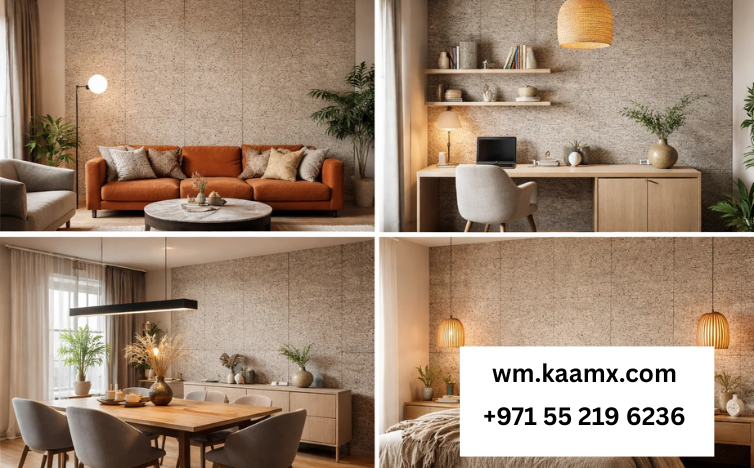
Dubai’s interior design conversation has been stuck in a loop for a long time. Marble. Glass. High gloss. Chrome. The surfaces that signal luxury in the Gulf have historically been the hardest, most reflective ones available — and they look magnificent in photographs and in empty showrooms. In actual daily use, in occupied spaces where people work, eat, sleep, and recover, they create acoustic environments that are exhausting to be in.
Something is shifting. Slowly but perceptibly, Dubai’s better commercial and residential interiors are moving toward materiality that has texture, warmth, and physical depth. Timber, stone, woven surfaces, natural finishes. The visual language of materials that connect to something organic rather than purely industrial. And quietly, without most people recognising it as an acoustic product, wood wool panels are appearing with increasing frequency in exactly the spaces that have made this shift.
They belong there. Not just aesthetically. Structurally, technically, and specifically for the conditions Dubai creates for interior materials.
What Wood Wool Actually Is — Not How It’s Usually Described
The marketing description of wood wool panels — “eco-friendly soundproofing material made from wood fibres, cement, and water” — is accurate but tells you almost nothing about why the material performs the way it does or why it’s appropriate for Dubai specifically.
The structure of the panel is what matters. Wood fibres — long, fine strands from renewable softwood — are mineralised with Portland cement and compressed into boards. The result is a rigid panel with an open, fibrous surface structure that is simultaneously porous enough to absorb sound waves and dense enough to be structurally stable, fire resistant, and dimensionally stable in conditions that would cause other acoustic materials to swell, compress, or degrade.
That last point is the one that makes wood wool specifically relevant for Dubai. The material’s cement binding makes it resistant to the humidity cycling that damages organic acoustic materials in the Gulf climate. The mineralised fibre structure doesn’t absorb ambient moisture the way natural wood panels do. It doesn’t support mold growth. It doesn’t change dimensions significantly in response to seasonal humidity swings. A wood wool panel installed in a Dubai restaurant in January will be performing identically in August, which is not a claim all acoustic panel materials can make honestly in this climate.
The Acoustic Performance Behind the Natural Appearance
The visual character of wood wool is what most people notice first. The texture — the woven surface of fine wood strands embedded in a pale cement matrix — reads as sophisticated, natural, and deliberately considered. It doesn’t look like an acoustic product. It looks like a design decision. This is genuinely unusual in the acoustic treatment world, where most products announce their functional purpose visually and require conscious design integration to avoid looking like they were added after the interior was completed.
The acoustic performance behind this appearance is substantive. Wood wool panels achieve NRC ratings of 0.8 to 1.0 depending on thickness and mounting conditions — at the top of the performance range for wall-mounted panels. An NRC of 1.0 means essentially complete absorption of the sound energy that strikes the panel surface across the target frequency range. In practical terms, this means a sufficient coverage area of wood wool panels transforms a reverberant Dubai commercial space — a restaurant, a hotel lobby, a conference room — into an acoustically controlled environment where conversation is clear, ambient noise feels contained, and the space is noticeably more comfortable to occupy.
The 24mm thickness option performs meaningfully better at lower frequencies than the thinner 9mm and 12mm options — important for spaces where bass-heavy music, mechanical HVAC noise, or low-frequency speech content is a significant component of the acoustic problem. For most commercial interiors in Dubai, the 25mm specification is the default recommendation precisely because the frequency range where Dubai’s commercial spaces most commonly struggle — the 250Hz to 500Hz range where HVAC drone and vocal fundamental frequencies overlap — is where additional material depth pays acoustic dividends.
The Thermal Benefit That Dubai Interiors Actually Need
Most acoustic panel products provide one function: acoustic absorption. Wood wool provides two simultaneously, and the second one is particularly relevant in Dubai’s climate context.
The cement-mineralised wood fibre structure has genuine thermal mass — it absorbs heat slowly and releases it slowly, buffering the temperature swings that Dubai’s intense solar gain through glass facades creates in interior spaces. For restaurants and retail spaces with significant glass frontage facing west or south, this thermal buffering effect — while not a substitute for proper insulation — contributes to maintaining more stable interior temperatures during the hours of peak solar loading. The air conditioning has less temperature variation to manage, which translates to lower energy consumption and more consistent comfort for occupants.
The thermal performance also protects the panels themselves. Materials that expand and contract significantly with temperature change create installation problems over time — gaps at panel joints, surface cracking, adhesive failures. Wood wool’s thermal stability means it moves minimally with the temperature fluctuations Dubai commercial interiors experience, maintaining the clean, consistent appearance of the installation over years of use rather than developing the subtle surface distortions that temperature-sensitive materials accumulate.
Why Dubai’s Hospitality Sector Has Adopted Them First
Look carefully at the newer restaurant openings in Dubai’s Design District, the DIFC dining scene, and the hotel lobby renovations happening across JBR and Downtown — and wood wool panels appear consistently as a wall or ceiling treatment in the spaces that have been designed with the most attention to material quality.
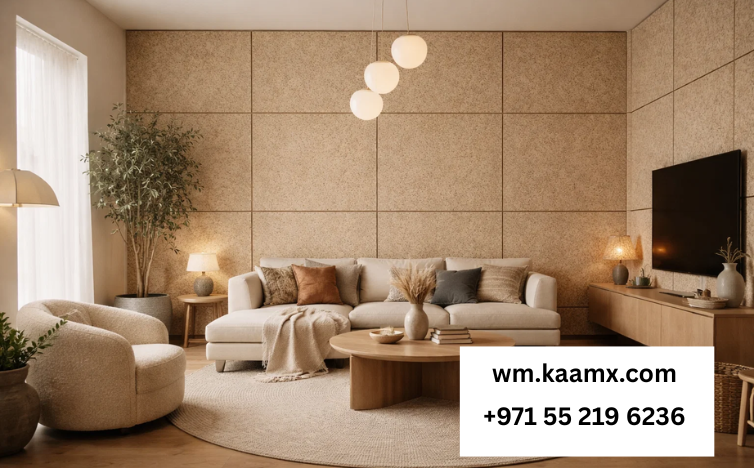 The hospitality sector reached this material first because hospitality interiors face the most demanding version of the performance-versus-aesthetics tension that all acoustic treatment involves. A restaurant cannot have walls that look like acoustic treatment. The visual character of the space is the brand. But a restaurant with untreated hard surfaces and a 1.5 second reverberation time gets reviewed as “too noisy” regardless of everything else it does well — and in Dubai’s review-driven hospitality market, noise complaints in Google reviews compound with every subsequent customer who reads them.
Wood wool solves this problem specifically because it doesn’t look like a compromise. A feature wall of wood wool panels in a warm natural tone, ceiling-to-dado height, in a Dubai restaurant reads as a considered material selection — the same visual register as exposed brick, terracotta tile, or raw timber. The client sitting at the table perceives an elevated interior. The acoustic engineer checking the reverberation time reads an NRC of 0.9. Both are right. Both are getting what they wanted from the same material decision.
The Education and Healthcare Specification That Makes Sense
Beyond hospitality, wood wool panels have found particularly strong application in two sectors where both acoustic performance and material safety are simultaneously non-negotiable.
In Dubai’s international school and education facility sector — the GEMS schools, the curriculum-diverse private schools across Jumeirah, Mirdif, and Arabian Ranches — wood wool panels address the speech intelligibility problem that affects learning outcomes in acoustically poor classrooms. Research from the Acoustical Society of America has documented that children with developing language skills need reverberation times below 0.6 seconds in classroom environments to process speech clearly. Dubai’s typical classroom construction — tiled floors, plastered walls, hard ceilings — produces reverberation times above 1.0 seconds routinely. Wood wool panels on rear and side walls bring this into the functional range while presenting a surface that is durable enough for institutional use, fire-rated to Class A standards for educational building requirements, and visually appropriate for an environment where both staff and children are the audience.
Healthcare applications benefit from wood wool’s material safety profile alongside its acoustic performance. The panel’s composition — mineralised natural fibres — does not off-gas volatile organic compounds, does not support microbial growth on its surface, and presents no hygiene risk in clinical adjacency. For Dubai clinics, therapy centres, and hospital waiting areas where acoustic absorption is clinically beneficial and material safety is a baseline requirement, wood wool occupies a specification position that few other acoustic materials can fill.
Colour, Texture, and the Customisation Question
The standard wood wool panel presents in natural tones — the pale grey-white of mineralised wood fibre with warm wood strand texture visible throughout. This neutral palette is genuinely versatile and integrates with a wide range of interior colour schemes without requiring customisation.
For interiors with specific colour requirements — branded commercial spaces, hospitality environments with defined colour palettes, residential installations where the panel needs to sit within a carefully calibrated scheme — wood wool panels can be factory-finished in a range of colours or site-painted after installation using breathable mineral-based paints that don’t seal the panel’s porous surface and therefore don’t compromise its acoustic performance. This is a specific technical requirement that some clients miss: applying a standard interior emulsion at full coverage can significantly reduce the panel’s NRC by blocking the pore structure through which sound absorption occurs. Mineral-based or diluted application preserves both the colour finish and the acoustic function.
The 1200mm x 600mm panel size in Dubai’s market creates installation rhythms — the grid pattern of joints between panels — that can be designed to contribute to the interior’s visual organisation rather than simply tiling a wall uniformly. Panel orientation, joint alignment with other architectural elements, and mixing of different thickness specifications for visual relief are all tools that skilled interior designers have used to make wood wool installations feel purposeful rather than repetitive.
Contact Muhammad Shaheen Carpentry at 971 55 219 6236, and discover the transformative science of soundproofing for your space.
The Specification Decision Worth Making Early
Wood wool panels reward early specification in a project. Their thermal mass means they contribute more effectively to temperature stability when installed as part of the initial fit-out rather than added later. Their dimensional stability makes them straightforward to integrate with other finishes during construction. And their visual character — which does best when it relates to the broader material palette of the space — is most successfully resolved when the designer is thinking about the acoustic treatment as a design element from the concept stage rather than specifying it as a remediation after the interior is finished.