
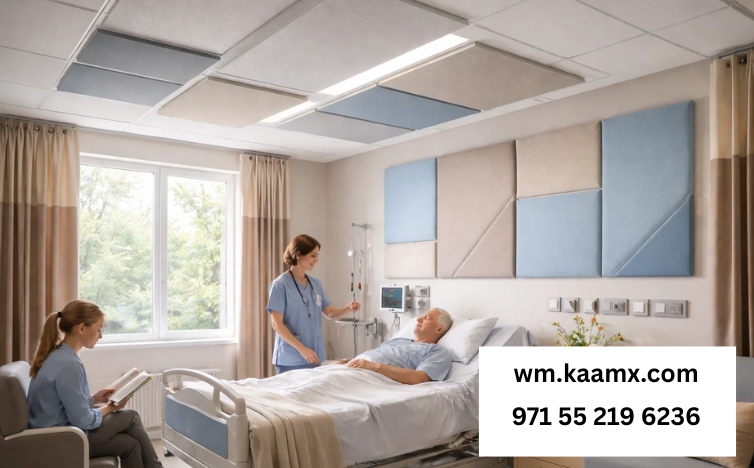
There’s a detail buried in the discharge paperwork of hospitals around the world that never gets discussed in patient satisfaction surveys: how much sleep the patient actually got during their stay. Ask any hospital inpatient honestly and the answer is almost universally the same. Not enough. Not restful. Interrupted repeatedly. Not by their condition — by the noise.
This is not a minor comfort issue. It is a clinical one. And in Dubai’s busy, fast-growing healthcare sector — where hospitals operate in dense urban environments, serve high patient volumes, and compete aggressively on patient experience — the acoustic quality of clinical spaces has direct, measurable consequences for the outcomes those facilities are delivering.
The research has been consistent for decades. The healthcare industry has been slow to act on it. That gap is closing — but not fast enough, and not in every facility that should be addressing it.
What the Research Actually Says About Hospital Noise and Recovery
The World Health Organization recommends that hospital ward noise levels should not exceed 35 decibels at night and 40 decibels during the day. These are the thresholds at which patients can maintain reasonable sleep quality and avoid stress-related physiological responses to their acoustic environment.
Studies across major teaching hospitals globally have consistently measured actual ward noise levels at 60 to 70 decibels during the day and 50 to 60 decibels at night — double and triple the WHO recommended levels. A 2021 systematic review published in the British Medical Journal found that hospital noise is directly associated with increased patient anxiety, elevated blood pressure, disrupted sleep architecture, slower wound healing, and longer inpatient stays. Not correlated with — causally linked to. The noise itself is making patients heal more slowly.
The mechanism is physiological and well-established. Unexpected or uncontrolled noise activates the sympathetic nervous system — the fight-or-flight response — releasing cortisol and adrenaline. In a healthy person this response is transient. In a patient whose body is already directing resources toward healing, sustained sympathetic activation competes directly with recovery processes. The immune function, the hormonal regulation, the tissue repair cascades — all of these are compromised when the nervous system is continuously managing a perceived threat environment. Hospital noise is that threat environment, operating continuously through the patient’s most vulnerable period.
Dubai Hospitals Face Specific Acoustic Challenges
Every hospital deals with internal noise. Dubai hospitals deal with that plus an external acoustic environment that most of the world’s healthcare facilities don’t face at the same intensity.
Dubai’s hospitals are distributed across the city’s most commercially active zones. Rashid Hospital sits adjacent to major road infrastructure. Mediclinic City Hospital operates within the Dubai Healthcare City development surrounded by construction and urban activity. The private hospital network in JLT, Business Bay, and the Jumeirah corridor faces the sustained traffic noise profiles of some of Dubai’s busiest arterials. The patients recovering in these facilities are simultaneously managing the physical demands of healing and the acoustic demands of one of the world’s most consistently noisy urban environments.
Standard hospital construction — concrete frame, hard floor finishes, institutional ceilings, functional rather than acoustic windows — does little to attenuate this external noise load. A private patient room in a Dubai hospital facing a major road may have an ambient noise level of 50 to 55 decibels at night from external traffic alone — before any internal hospital noise is added. That’s 15 to 20 decibels above the WHO recommended nocturnal limit before the hospital has done anything wrong operationally.
The Internal Noise Sources That Add to an Already Stressed Environment
External noise is the layer most people think of first. The internal noise sources that Dubai hospital patients actually report as most disruptive tell a different story.
HVAC systems are the most pervasive and least acknowledged hospital noise source. Dubai’s climate demands heavy air conditioning running continuously. Hospital HVAC systems are large, powerful, and in older or less carefully specified buildings, poorly attenuated. The constant low-frequency hum of air handling units penetrates patient rooms through ductwork, wall penetrations, and structural transmission. Patients describe this as exhausting in a way that intermittent louder sounds are not — because it never stops. The auditory system cannot habituate to a sustained stimulus the way it can tune out an intermittent one.
Corridor traffic — footsteps, equipment wheels, conversations between staff — creates intermittent high-level noise events that are particularly disruptive to sleep because their unpredictability prevents habituation. Research from Johns Hopkins University found that it is specifically the unpredictability of hospital noise — not the overall level — that most strongly disrupts patient sleep. A patient can sleep through a consistent 55 dB HVAC hum more easily than through a series of 60 dB door slams at unpredictable intervals. The acoustic design implication is that controlling peak noise events — door impacts, equipment noise, corridor sound transmission — matters as much as reducing average noise levels.
Medical equipment — infusion pump alarms, monitoring system alerts, ventilator sounds — is the category that hospital acoustic designers must work around rather than eliminate. These sounds are clinically necessary. The design challenge is containing them to the spaces where they need to be heard rather than allowing them to transmit through walls and doors to patients who don’t need to hear them and for whom they serve only as an alarm and a sleep disruptor.
Patient Privacy — The Legal and Ethical Dimension
The acoustic quality of Dubai’s hospitals is not purely a clinical recovery issue. It is a patient privacy issue with regulatory and legal dimensions that healthcare facilities operating in the UAE cannot afford to ignore.
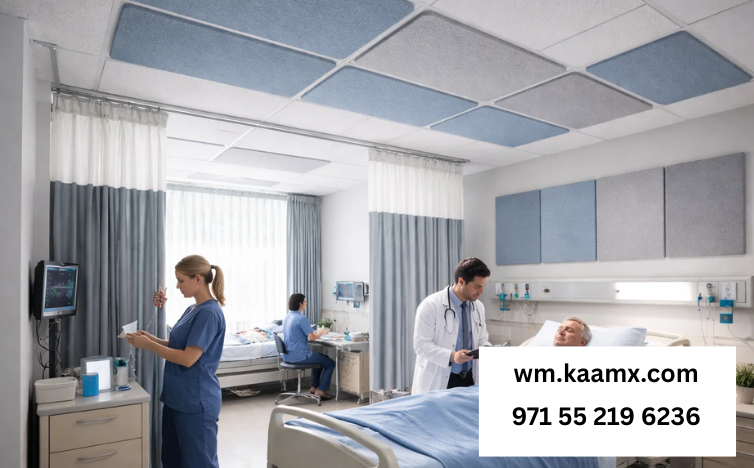 Consultation rooms where a patient’s diagnosis, treatment plan, and personal medical information can be heard through the partition wall from a waiting area are not compliant with healthcare privacy standards. UAE Federal Law on Health Data Privacy and the Dubai Health Authority’s own guidelines impose obligations on healthcare facilities to ensure that patient information remains confidential — and acoustic inadequacy in consultation room design is a direct structural compliance failure.
In practice, this failure is widespread and accepted as normal in many Dubai clinical facilities. Patients in waiting rooms hear conversations from behind consultation room doors. Patients in adjacent beds hear each other’s medical discussions with nursing staff. The design of these spaces was not acoustically considered, and the legal exposure this creates for the facility is real and growing as healthcare privacy regulation in the UAE matures.
Acoustic treatment of consultation rooms — wall panels for absorption, Mass Loaded Vinyl for transmission loss, acoustic doors with proper perimeter sealing — addresses this compliance gap directly and permanently. For Dubai healthcare facilities conducting any form of sensitive clinical consultation, this treatment is not optional on a risk-managed basis. It is a facility design obligation.
The ICU and Recovery Room — Where Acoustic Design Has the Highest Clinical Stakes
If there is one space type in Dubai’s hospital environment where acoustic treatment has the most directly measurable clinical impact, it is the Intensive Care Unit and the post-operative recovery room.
ICU patients are physiologically the most vulnerable to the consequences of acoustic stress. Many are sedated but not fully unconscious — meaning they are experiencing the acoustic environment without the capacity to consciously filter or habituate. The stress response to uncontrolled noise operates at a neurological level that sedation does not fully suppress. Cortisol elevation in ICU patients exposed to high ambient noise has been documented even in deeply sedated patients — a finding that fundamentally challenges the assumption that sedated patients don’t need acoustic protection.
Post-operative recovery rooms present a slightly different challenge: patients transitioning out of anaesthesia are in a heightened neurological sensitivity state where acoustic inputs are processed more intensely than normal. Sudden loud sounds during recovery from anaesthesia create acute stress responses that can affect cardiovascular stability — a clinical concern, not just a comfort one. The acoustic environment of the recovery room is not peripheral to clinical care in this context. It is part of it.
Treatment for ICU and recovery room spaces requires the most stringent acoustic specification in the entire hospital — both for isolation from corridor and adjacent room noise and for internal reverberation control. Acoustic ceiling panels, wall treatment with clinically safe materials, acoustic glass for glazed observation panels, sealed acoustic doors, and careful HVAC attenuation combine to create environments where the acoustic design actively supports the clinical outcomes rather than working against them.
What Acoustic Treatment for Dubai Hospitals Actually Involves
The specification of acoustic treatment for Dubai hospital environments is more complex than commercial office acoustic treatment because it must satisfy simultaneous clinical, hygiene, and acoustic requirements that can point in different directions.
Materials in patient areas must be non-toxic, non-allergenic, and cleanable to clinical hygiene standards — many acoustic panel materials that perform excellently in commercial environments are unsuitable for clinical spaces because they cannot withstand the cleaning protocols that infection control requires. Sealed-face acoustic panels with antimicrobial fabric coverings or impermeable surfaces that maintain acoustic performance while meeting infection control standards are the appropriate specification for patient room and ward environments.
Acoustic doors for hospital wards and consultation rooms need to achieve STC ratings of 45 or above to provide meaningful conversation privacy — while also being specifiable with the hardware requirements of a clinical environment: vision panels for patient observation, kick plates for trolley protection, and appropriate door closer specifications. Standard commercial acoustic doors don’t satisfy these requirements without clinical adaptation.
HVAC noise attenuation requires acoustic lining in ductwork, vibration isolation for air handling units, and careful diffuser selection to minimise the turbulence noise that standard hospital HVAC diffusers generate. This is a specialist intersection of mechanical engineering and acoustic design that requires coordination between the acoustic treatment contractor and the HVAC engineer from the earliest stage of the project.
Wm.kaamx.com’s hospital and clinic soundproofing services in Dubai address this full specification complexity — from consultation room acoustic doors and wall treatment to ward acoustic ceiling systems and HVAC noise attenuation — with materials specified for clinical hygiene compatibility and installation approaches that minimise disruption to ongoing facility operations. For Dubai healthcare facilities serious about both clinical outcomes and regulatory compliance, this integrated approach is the only one that addresses all the relevant requirements simultaneously.
Contact Muhammad Shaheen Carpentry at 971 55 219 6236, and discover the transformative science of soundproofing for your space.
The Investment Case That Healthcare Administrators Need to Hear
Acoustic treatment in hospitals is consistently evaluated as a capital expenditure line item competing against clinical equipment, IT infrastructure, and facility expansion. This framing undervalues it.
A 2020 study from the University of Chicago’s healthcare economics group found that patients who rated their hospital stay as “quiet at night” had statistically significantly shorter inpatient stays than those who rated it poorly — with the difference averaging 0.8 days per admission. In a Dubai private hospital context where inpatient day rates run from AED 2,000 to AED 8,000 depending on the ward class, shorter stays from improved acoustic quality represent bed turnover improvement and cost reduction simultaneously. The acoustic treatment that produces this outcome pays for itself within a relatively small number of patient admissions.
The reputational and competitive dimension adds further weight. Dubai’s private healthcare market is intensely competitive. Patient experience scores — specifically those related to sleep quality and noise management — are increasingly visible through review platforms and are factors in patient choice for elective procedures and specialist consultations. Facilities that consistently score poorly on noise management lose patient volume to competitors who don’t. The acoustic quality of a Dubai hospital is not separate from its commercial performance. In an era of transparent patient feedback, it is directly part of it.